

Imagine two young Christians having a conversation about salvation.
Both love Jesus.
Both believe the Bible is the inspired Word of God.
Both pray for the guidance of the Holy Spirit.
Both sincerely want to follow Christ.
Yet they come to very different conclusions about one of the most important questions in Christianity: How are we saved?
Let’s listen in.
“Salvation is by faith alone,” says the Protestant.
“The Bible is clear. Jesus said, ‘Whoever believes in him should not perish but have eternal life’ (John 3:16).”
He continues:
“Jesus also said, ‘Whoever hears my word and believes him who sent me has eternal life’ (John 5:24). Paul wrote, ‘If you confess with your mouth that Jesus is Lord and believe in your heart that God raised him from the dead, you will be saved’ (Romans 10:9).”
Then he adds one of the most familiar passages:
“For by grace you have been saved through faith. And this is not your own doing; it is the gift of God, not a result of works” (Ephesians 2:8-9).
“It seems obvious,” he says. “We’re saved by faith alone.”
The Catholic responds.
“I agree that we are saved by grace through faith. Catholics believe that too. The question is whether Scripture teaches faith alone, or whether the faith that saves is a living faith that works through love.”
He points to the very next verse in Ephesians:
“For we are his workmanship, created in Christ Jesus for good works, which God prepared beforehand, that we should walk in them” (Ephesians 2:10).
Then he turns to another passage:
“In Christ Jesus neither circumcision nor uncircumcision counts for anything, but only faith working through love” (Galatians 5:6).
He continues:
“Paul also writes that God ‘will render to every man according to his works: to those who by patience in well-doing seek for glory and honor and immortality, he will give eternal life’ (Romans 2:6-7).”
The Protestant pauses.
The Catholic goes on.
“What about Matthew 25? Jesus separates the sheep from the goats. The sheep inherit the kingdom because they fed the hungry, clothed the naked, and cared for those in need. The goats are condemned because they failed to do those things.”
Then he opens James:
“You see that a man is justified by works and not by faith alone” (James 2:24).
The Protestant responds quickly.
“Those verses don’t mean our works earn salvation. Salvation is God’s gift.”
The Catholic answers:
“I agree. Catholics don’t believe we can earn salvation either. But notice what just happened. You quoted verses that appear to support faith alone. I quoted verses that appear to reject faith alone. We’re both appealing to Scripture.”
The Protestant nods.
“And we’re both asking the Holy Spirit to guide us,” the Catholic adds.
Again, the Protestant agrees.
Now the conversation reaches a deeper level.
“So how do we determine who is right?” asks the Catholic.
“The answer is simple,” says the Protestant. “We follow what the Bible says.”
“But that’s exactly what I’m trying to do,” replies the Catholic.
The Protestant thinks for a moment.
The Catholic continues.
“Millions of Christians believe they are following the Bible. Baptists, Presbyterians, Lutherans, Methodists, Pentecostals, Reformed Christians, and Catholics all appeal to Scripture. They all claim to seek the guidance of the Holy Spirit. Yet they often disagree on important doctrines.”
“So one of them is wrong,” says the Protestant.
“Perhaps,” says the Catholic. “But how do we know which one?”
The Protestant responds:
“If they’re wrong, they’re sincerely wrong.”
The Catholic nods.
“Then we’ve uncovered another problem.”
“What problem?” asks the Protestant.
“If sincere Christians can read the same Bible, pray to the same Holy Spirit, and still reach opposite conclusions, where does certainty come from?”
The conversation is no longer merely about faith alone.
It has become a discussion about authority.
The Protestant says Scripture alone is the final authority.
But the Catholic points out that Scripture never interprets itself. People interpret Scripture. And sincere believers often reach conflicting conclusions.
Simply saying “follow the Bible” does not solve the problem because every side claims to be doing exactly that.
The real question becomes: Who has the authority to settle disagreements when Christians interpret Scripture differently?
The question is not whether Christians should read Scripture. Of course they should. The question is what happens when sincere Christians disagree about what Scripture means.
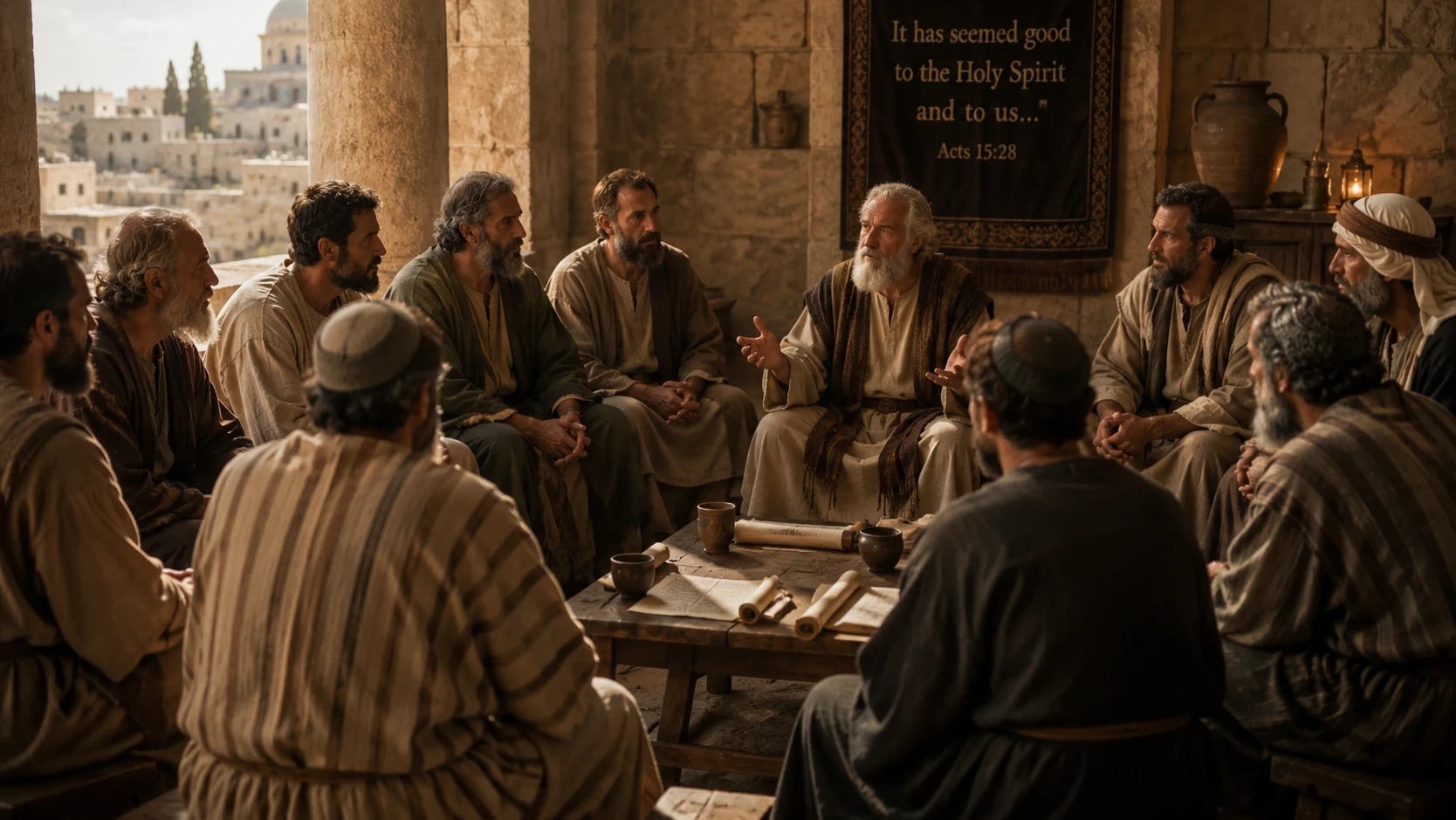
The New Testament shows that doctrinal disputes existed even in the apostolic age. In Acts 15, the early Church did not solve a major controversy by sending everyone home to study the Scriptures individually and reach their own conclusions. The apostles and elders gathered together, deliberated, and issued an authoritative judgment for the Church.
For Catholics, that pattern continues. Christ established a Church, gave authority to the apostles, and promised to guide His Church into truth.
The issue, then, is not whether Scripture is true. Catholics and Protestants both affirm that.
The issue is whether Christ intended Scripture to function as the sole rule of faith interpreted by individual believers, or whether He also established a teaching authority to preserve and interpret the apostolic faith.
That is why debates about faith alone often lead to a larger question.
Not simply, “What does this verse mean?”
But rather, “Who has the authority to determine what it means?”
Until that question is answered, Christians will continue to quote competing verses, claim the guidance of the Holy Spirit, and arrive at different conclusions.
That does not prove Catholicism is true.
But it does raise an important question:
If Christ intended Scripture alone to be the final authority for Christians, why do sincere believers who appeal to Scripture alone reach such different conclusions?
And how did the earliest Christians resolve those disagreements?
Those questions deserve careful consideration.
Further Reading:
Faith Alone? Understanding Ephesians 2:8-9 And The Role Of Works In Salvation
What James 2 Really Says About Faith And Works — “Not Faith Alone”
Why Do Christians Disagree On The Bible? Understanding The Problem Of Sola Scriptura
Apostolic Succession: What The Bible Really Says About Church Authority
How To Identify The True Christian Church: Why The Early Church Still Matters